
Medical Weight Loss Tampa | medicalweightlosstampa.com
medicalweightlosstampa.com | Tampa, FL
Explained by the Clinical Team at Medical Weight Loss Tampa
Published: October 14, 2026 | Updated: October 14, 2026
Sometimes it’s frustrating when your proven routine stops giving you results. If diet and exercise used to work but suddenly fail to move the scale, an internal shift could be holding you back. The only way to deal with such a dilemma is to go for a comprehensive blood work analysis, hormone level testing and an all-round diagnosis of your overall health to determine where exactly the problem might be. Once you have that, it becomes possible to take the necessary corrective measures.
Key points
- A slowing metabolism is not a character flaw, it is a documented physiological response
- BMI above 30, or above 27 with a related condition, is the standard clinical threshold for medical evaluation
- Two or more serious attempts at self-directed weight loss without lasting results is a reasonable trigger to ask for help
- Tampa's own health data gives Floridians more reason to act early than most of the country
Everybody lies. Not maliciously. Not even on purpose, most of the time. A patient sits down and says “I eat pretty healthy” and means it, the same way a patient with a fever says “I feel fine” right before collapsing in the waiting room. The story people tell about their own weight loss struggle is almost never the whole story and it’s rarely the story their bloodwork tells.
What Actually Counts as “Struggling” With Weight Loss
Struggling doesn't mean you ate a cookie on a Tuesday. It means a pattern. If you have been working out and eating healthy for six months with little to no progress, you most likely have an underlying health issue that prevents you from losing weight.
If you have tried, genuinely tried more than once and the result keeps landing in the same place, the problem was never your effort. Insulin resistance, thyroid dysfunction, PCOS, sleep apnea, certain antidepressants, menopause, and simple aging all shift the chemistry of hunger and fat storage in ways a gym membership can't touch.
The Body Has a Memory, and It Is Not on Your Side
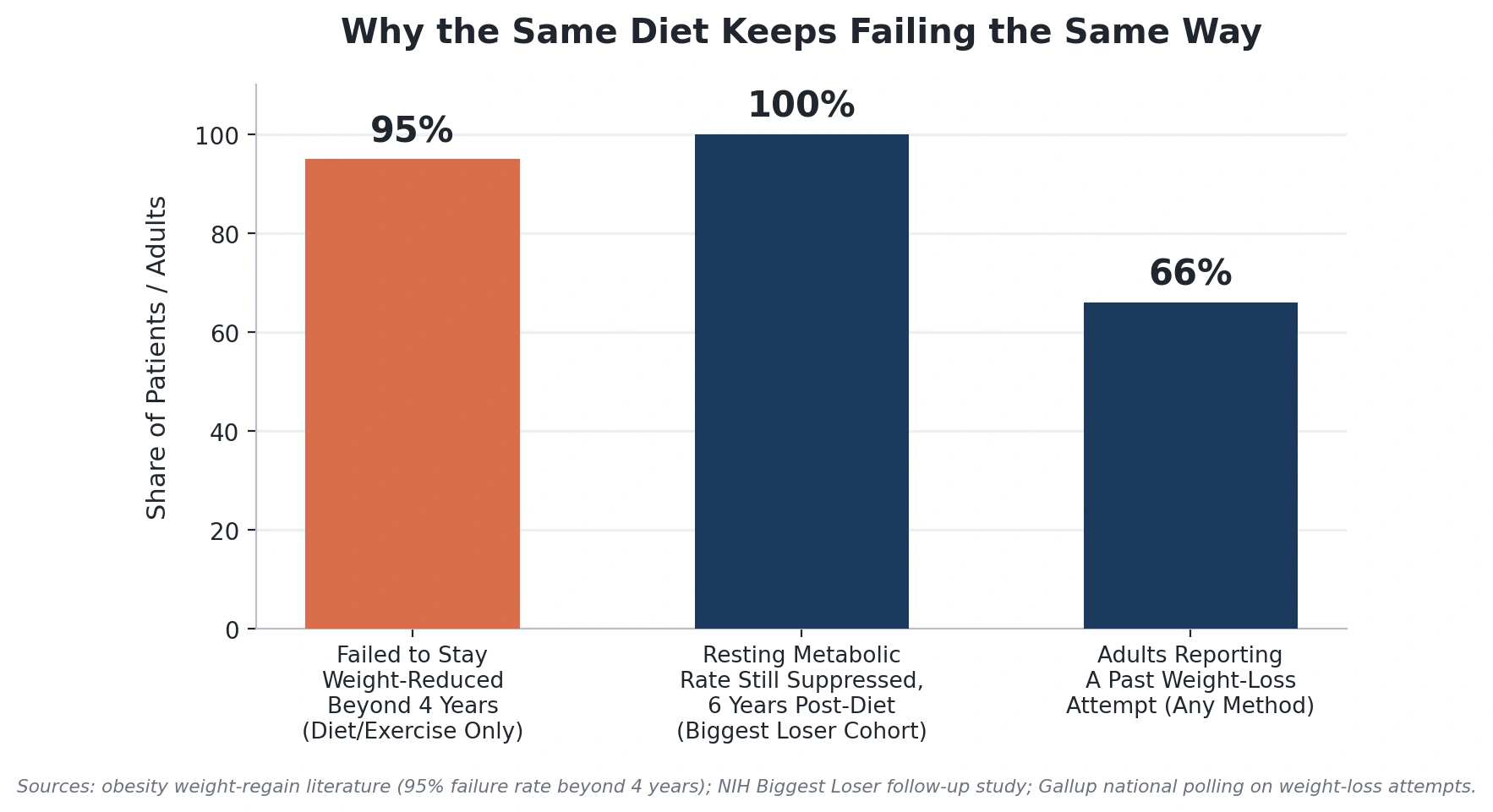
A National Institutes of Health follow-up study tracking contestants from a well known televised weight loss competition found their resting metabolic rate was still running roughly 500 calories a day slower than expected six years after the show ended, even in people who had regained most of the weight. The body does not forget a period of restriction. It adapts to it and then it defends that adaptation for years.
Separate obesity treatment literature puts the failure rate at 95% for people trying to stay weight-reduced past four years using diet and exercise alone. Read that again. That number has everything to do with leptin, ghrelin and a resting metabolism that has been quietly reset without anyone's permission.
Florida Makes This Personal, Not Just Statistical
Tampa is not immune to any of this, and the data says the opposite of immune. Florida is now the 8th most obese state in the nation, with 29.6% of the state's adults being obese (BMI 30 or higher) in America's Health Rankings. Take a step back to the national level and the CDC's own surveillance data shows that 40.3% of all U.S. adults are obese, placing over 100 million Americans at a clinical cut-off point today, reading this.
FLORIDA ADULT HEALTH & ECONOMIC IMPACT
Florida adults with a BMI of 30 or higher, 8th highest in the US
Annual hit to Florida's economy from obesity-linked lost productivity
Failure rate for unsupervised weight loss lasting past 4 years
The economic side stings just as much locally. A 2026 obesity impact analysis from GlobalData put the annual cost to Florida's economy at 33.2 billion dollars in lost productivity and workforce impact, with obesity-related premature mortality claiming an estimated 48,800 lives a year statewide. Households here are also absorbing roughly 2 billion dollars a year in out-of-pocket obesity-related medical spending.
5 Signs the DIY Approach Has Run Its Course
Before the list, a quick gut check. If any of the five signs below describe you, a visit to explore medical weight loss options in Tampa is worth more than another month of guessing.
How to Know You Are Getting A Real Evaluation
A legitimate medical weight loss consult starts with lab work, because you can't treat what you haven't measured. Before anything like a treatment plan is suggesting, there will be a thyroid-stimulating hormone test, a full metabolic panel, blood glucose and possibly a resting metabolic rate test. There are a variety of other options, from nutritional counseling and behavior-based coaching to hormone replacement therapy for menopause weight gain, to GLP-1 and dual-agonist medications, like semaglutide and tirzepatide, prescribed under a physician's supervision.
“Patients come in convinced they've failed at every diet they've tried, when the truth is the diet failed them first. Once we run real labs and look at what's actually driving the weight gain, whether that's insulin resistance, a hormone shift, or years of metabolic adaptation from past dieting, the plan stops being guesswork and starts being medicine.”
— Dr. Emily Devol Webster, Medical Director, Medical Weight Loss Tampa
A program built around personalized nutritional counseling paired with medical supervision treats the actual mechanism. A program built around calorie counting alone treats the symptom and hopes the mechanism cooperates.
Get Actual Answers
A $47 evaluation includes a full consultation, health assessment, and personalized treatment plan.
Reading the BMI Chart Honestly
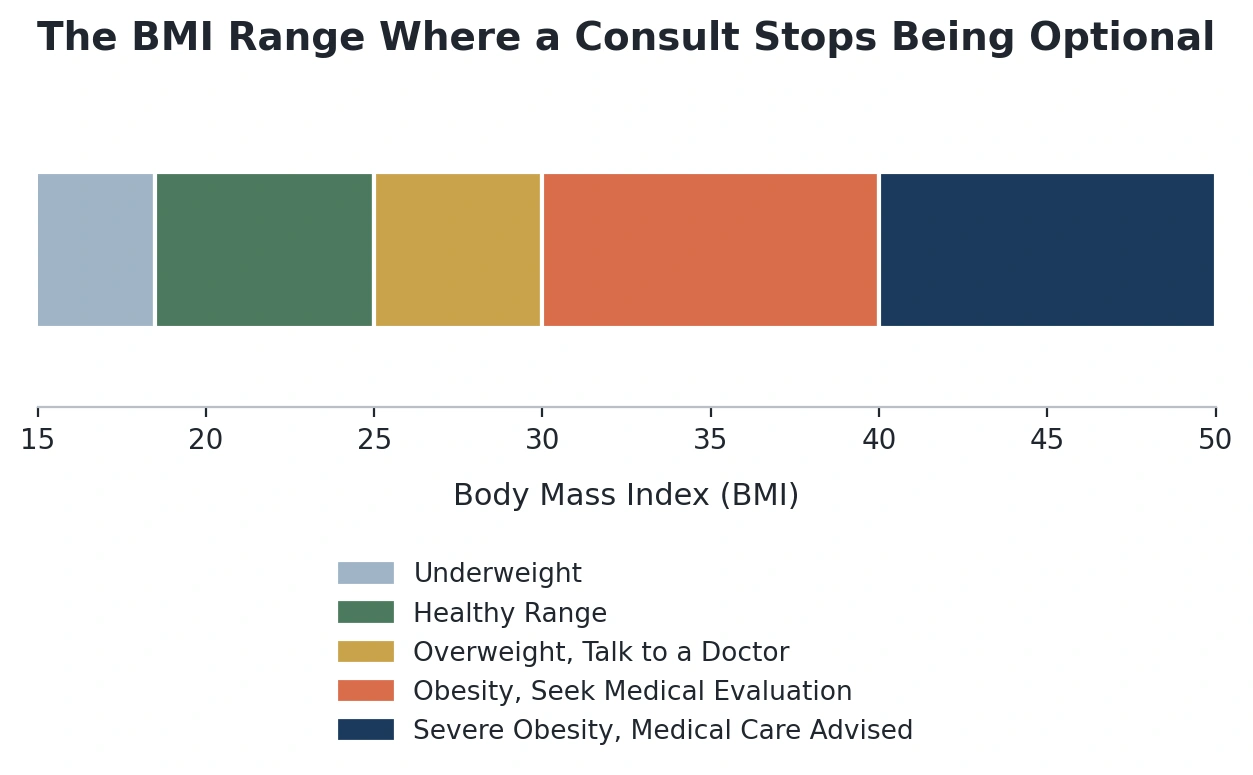
Look at where the gold band ends and the orange one begins. That line at 30 is the point where the National Institutes of Health and most obesity medicine specialists agree that only lifestyle advice stops being a sufficient response. Below 25, keep doing what you are doing. Between 25 and 30, a conversation with a doctor is reasonable. Above 30, or above 27 with a related condition, a conversation with a doctor is closer to necessary.
A Table Worth More Than a Thousand Motivational Quotes
| Approach | Typical Timeline | What It Actually Treats |
|---|---|---|
| Calorie counting apps | Weeks to months | Intake tracking, not hormones |
| Generic gym program | Months | Brawn and cardiac fitness |
| Fad or crash diets | Days to weeks | Short-term water weight |
| Physician-supervised program | Months to sustained | Metabolic, hormonal, and behavioral drivers together |
Notice which row is the only one built to survive contact with a slowed metabolism. The others were never designed to fight biology. They were designed to fight boredom, and biology does not get bored.
What Makes Tampa's Situation Worth Watching Closely
Climate has a less prominent part in this than one might think. After nine months of heat index alerts, the nation's residents are forced to choose between early morning hours or gym memberships to get outside and exercise, whereas warmer states aren't having to make the decision.
Throw in convenient drive-through options, long Bay commute times and a culture of convenience, and the deck is stacked before anyone even opens up the menu. None of that is a moral failing either. It’s geography and infrastructure working against biology, which is exactly the kind of problem medicine, not motivation, is built to solve.
The Actual Answer to “Am I Ready”
You are ready the moment you can honestly say 2 things. First, that you have made a genuine effort more than once. Second, it fell apart because the results just stopped lining up with the work you were putting in. That mismatch between your effort and the outcome? It’s the clearest sign in medicine that something deeper may be going on, and it's worth getting another opinion.
During a consultation, there’s no pressure to get on any drugs, have surgery or anything dramatic. It offers real data, not speculation, lab numbers, not strangers' Instagram feeds. And a plan that’s specific to your unique chemistry, not a stranger's. That’s a low bar to clear for a decision this consequential. Booking a consultation through Medical Weight Loss Tampa's new patient scheduling takes less time than the average grocery run, and it starts with the $47 evaluation rather than a guessing game.
Ready to Trade hunch for a Plan?
Personalized and physician-guided weight loss designed around your labs.
FAQ
Will I need to take medical weight loss medication for life?
Not exactly. Many people have treatments as a method to get them back to a normal metabolism and get them into habits that they can keep up for the rest of their life. Your doctor will make changes or reduce your plan when you have achieved your durable health targets.
Do I have to follow a special or limited diet?
Special/Restrictive diets aren’t really necessary. Importance is placed on the practice of a balanced diet that’s proper for you and your lifestyle.
Can stress and bad sleep prevent weight loss?
Yes. High cortisol can cause poor sleep and/or chronic stress, which can both interfere with the ability to be insulin sensitive and regulate appetite hormones, regardless of diet.
Is a medical weight loss evaluation covered by insurance?
Some plans will provide the initial consultation and any related labs (typically if a condition is found in the medical record) as well as ongoing treatment and medication, while some plans may not cover it.
Disclaimer: This article is for informational and educational purposes only. It shouldn’t be a substitute for medical advice. Always consult with a qualified healthcare practitioner before making any medical treatment decisions.